

|
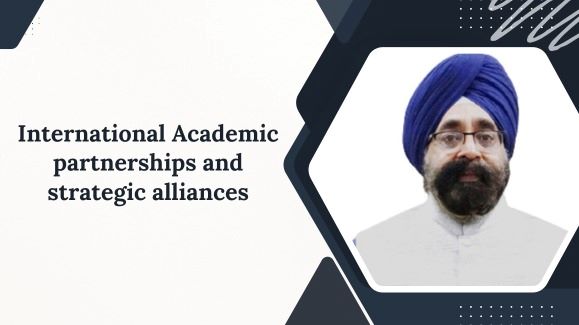
Prof. (Dr.) Parvinder Singh
Former Vice-Chancellor | Former Controller of Examinations, Panjab University | Higher Education Leader & International Academic Affairs Professional |
The global higher education landscape is undergoing a historic transformation. The university of the twenty-first century is no longer confined by the physical boundaries of its campus, city or country. Knowledge is increasingly crossing borders through international collaborations, joint degrees, dual-degree programmes, branch campuses, digital classrooms, collaborative research and global academic networks.
This emerging paradigm, broadly described as Transnational Education (TNE), represents one of the most significant developments in international higher education. It is changing not only where students learn, but also how universities collaborate, how academic programmes are designed and how knowledge is created and shared.
Transnational education is, therefore, much more than an internationalisation strategy. It is becoming a powerful instrument for building a globally connected, inclusive and innovation-driven higher education ecosystem.
From Student Mobility to Global Academic Mobility
For decades, international education was largely synonymous with student mobility. Ambitious students travelled overseas to study at renowned universities, gain international exposure and acquire globally recognised qualifications.
That model is evolving rapidly.
Today, internationalisation is increasingly about academic mobility in multiple dimensions. Programmes travel across borders. Faculty teach internationally. Universities establish collaborative centres and overseas campuses. Students undertake mobility semesters, international internships and virtual exchanges. Joint research teams work across continents, while digital technologies enable global classrooms without requiring every student to cross a physical border.
This transition has particular relevance for countries such as India. International academic partnerships can provide students with access to global curricula and expertise while allowing them to remain connected to their local communities and cultural environment.
The future is not simply about sending students abroad. It is about bringing the world into the classroom and taking Indian knowledge, talent and innovation to the world.
India at the Centre of the Transformation
India is exceptionally well positioned to emerge as a global hub for transnational education. Its large and diverse higher education system, young population, expanding research capabilities and growing demand for high-quality education provide an extraordinary foundation for international engagement.
The National Education Policy (NEP) 2020has given significant momentum to this vision. Its emphasis on internationalisation, multidisciplinary education, academic collaborations, research and innovation, flexible learning pathways and global engagement provides a strong framework for Indian universities to participate more actively in the international higher education ecosystem.
The entry and collaboration of reputed foreign universities can further strengthen Indias academic landscape. However, internationalisation should not be viewed merely through the lens of attracting foreign institutions or students. The real objective must be to create sustainable academic partnerships that enhance quality, research, innovation, employability and global competencies.
India should aspire to become not merely a destination for international students but a global knowledge partner.
The Rise of the Global Classroom
Technology has emerged as a major catalyst for transnational education. Digital learning platforms, virtual laboratories, artificial intelligence and immersive technologies are removing geographical barriers that once restricted international academic engagement.
A student studying in India can now attend a lecture delivered by an international professor, collaborate virtually with students from different countries, participate in a global research project and access academic resources from institutions thousands of kilo metres away.
Artificial Intelligence is likely to accelerate this transformation further. AI-enabled personalised learning, intelligent tutoring systems, adaptive assessments, virtual laboratories and multilingual learning platforms can make international education more accessible and flexible.
However, technology must remain an enabler not a substitute for the human values of education. The most effective model of the future is likely to beblended and hybrid international education, combining digital access with physical mobility, faculty interaction, industry exposure, cultural immersion and international internships.
Quality Must Remain Non-Negotiable
The expansion of transnational education also brings significant responsibilities. International partnerships must be built on academic integrity, transparency and robust quality assurance.
A degree delivered through a transnational partnership must provide students with comparable academic standards, regardless of where the programme is delivered. Accreditation, recognition of qualifications, credit transfer, assessment integrity, faculty quality, student protection and institutional accountability must therefore receive the highest priority.
Indias evolving quality assurance ecosystem, including the transformation towards more outcome-oriented and technology-enabled accreditation frameworks, can play a vital role in ensuring that internationalisation is accompanied by quality enhancement.
Universities must move beyond signing Memoranda of Understanding that remain largely ceremonial. The future belongs too utcome-driven partnerships that produce measurable results joint research publications, patents, innovation, faculty development, student mobility, entrepreneurship and meaningful employability outcomes.
The true value of an international partnership should be measured by its academic impact, not by the number of logos displayed on a website.
Internationalisation with Local Relevance
One of the greatest challenges before transnational education is to balance global standards with local needs.
A successful international programme must understand the social, economic and cultural realities of the country where it operates. Global curricula should be contextualised without compromising academic rigour.
For India, this means developing programmes that combine international perspectives with Indias unique strengths in areas such as technology, pharmaceuticals, healthcare, sustainability, management, agriculture, renewable energy and traditional knowledge systems.
The objective should be global competence with local relevance.
Beyond Degrees: Creating Global Citizens
The most profound contribution of transnational education may not be the degree itself. It is the development of individuals capable of working, communicating and collaborating across cultures.
Todays major challenges climate change, artificial intelligence, cybersecurity, pandemics, energy security, sustainable development and geopolitical instability cannot be addressed by one country or one discipline alone.
Universities must therefore prepare students not only for employment but also for global citizenship.
International exposure can cultivate intercultural understanding, empathy, critical thinking and the ability to appreciate diverse perspectives. These qualities are increasingly essential in a world where professional and social interactions transcend national boundaries.
Transnational education can thus become a bridge between societies a means of transforming international academic cooperation into international understanding.
The University Without Borders
The university of the future may no longer be defined by a single campus. It may function as a global network connecting physical campuses, digital platforms, international research centres, industry partners and innovation ecosystems.
The most successful universities will be those capable of combining global ambition with local responsibility.
For India, this is a moment of extraordinary opportunity. The country can emerge as a major global destination for higher education while simultaneously expanding its international academic footprint. Indian universities have the potential to build partnerships that are not merely transactional but transformational.
The next phase of internationalisation must therefore be guided by three principles: quality, credibility and mutuality.
Transnational education should not create a hierarchy in which one country teaches and another merely receives. Instead, it should create a partnership in which knowledge flows in multiple directions, research is co-created and institutions learn from one another.
The future of higher education is no longer simply local or international it is global, interconnected and collaborative.
Beyond borders, the university is becoming a global ecosystem. In this new era, the real measure of institutional excellence will be the ability to connect knowledge with humanity, innovation with inclusion, and global opportunity with local impact.
Transnational education is not merely changing the geography of higher education. It is redefining the very meaning of the global university.
Latest Posts
-
6th August, 2026
-
 3rd August, 2026