
|
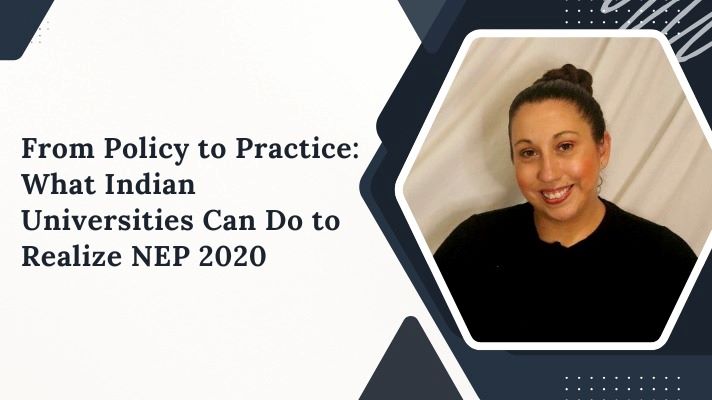
Prof. (Dr.) Cassie DeFillipo
English Language Fellow Pune, India & A program of the U.S. Department of State cassie.defillipo@gmail.com | +1 (541) 539 6031 |
The National Education Policy 2020 (NEP 2020) is Indias most significant education reform in decades. One important aspect of the policy is the Indian educational systems shift away from rote memorization toward student-centered learning. According to the NEP (2020), the future of education in India should include:
- emphasis on conceptual understanding rather than rote learning and learning-for-exams;
- creativity and critical thinking to encourage logical decision-making and innovation
Six years after its introduction, however, these goals are still not a reality in many university classrooms. While the vision is robust, widespread implementation is lacking.
Research in educational psychology and the learning sciences consistently shows that student-centered teaching where learners actively engage in discussion, problem-solving, and knowledge construction leads to stronger academic outcomes than traditional lecture-based approaches. A widely cited meta-analysis by Scott Freeman et al. (2014) found that active learning significantly improves exam performance and reduces failure rates in STEM courses, while subsequent work (e.g., Theobald et al., 2020) demonstrates that these approaches can also narrow achievement gaps for underrepresented students.
Research beyond STEM fields points to similar benefits. Studies in the humanities and social sciences have shown that student-centered and active learning approaches such as discussion-based seminars, collaborative projects, and writing-intensive pedagogies enhance critical thinking, engagement, and knowledge retention (e.g., Mick Healey Alan Jenkins, 2009; John C. Bean, 2011). In arts education, participatory and studio-based learning models have been linked to deeper conceptual understanding, creativity, and reflective practice (e.g., Elliot W. Eisner, 2002).
This body of research suggests that the benefits of student-centered teaching support both cognitive and affective dimensions of learning. Theoretical frameworks such as Constructivism and Blooms Taxonomy help explain these outcomes, as student-centered environments promote higher-order thinking, deeper conceptual understanding, and metacognitive awareness. In addition, these outcomes foster transferable skills that students can carry into the workplace and that make them more employable (David J. Prince, 2004; Association of American Colleges and Universities, 2015).
Research (e.g., Prince, 2004; Deslauriers et al., 2019) shows that while students may feel they learn less in active classrooms, they in fact demonstrate greater retention, transfer of knowledge, and engagement over time. As a student-centered professor, I have had this experience firsthand in India. I remember one student informing me that she felt she was having a lot of fun but doing less &work in my class. At the time, the comment caught me off guard. In retrospect, I realized she was responding to a different kind of classroom experience one that emphasized discussion and engagement over memorization. Student-centered learning does not always feel like traditional academic labor, even though it requires deeper intellectual effort. A year later, she reached out to share that she still remembered the class and the material. The experience highlighted a key insight from the research: what feels like less effort in the moment can actually result in more durable learning over time.
As a visiting professor in India, I have had the opportunity to visit and work with 20+ institutions. I quickly noticed the rote style of teaching is still prevalent across many faculties and universities. I also noticed that the primary obstacle to change does not seem to be faculty resistance. In fact, I was struck by how many professors demonstrated growth mindsets and a genuine willingness to adapt. The challenge thus lies in a mismatch between NEP 2020s vision and institutional realities, compounded by a lack of faculty training.
This mismatch can be found in two primary forms. First, assessment systems still prioritize memorization over critical thinking. Faculty across institutions and disciplines have repeatedly shared that they must prepare students for exams, making it difficult to incorporate project-based or student-centered approaches. Rigid syllabi, often packed with lecture content that must be completed in a fixed timeline, further limits flexibility. Large class sizes add another layer of constraint, making individualized attention and active learning more difficult to implement. Second, faculty members are being asked to adapt their teaching style without training. Many were themselves educated in lecture-based systems and have had little exposure to project-based or student-led learning. Expecting transformation without sustained professional development is unrealistic.
My experience teaching in India, combined with training and teaching across the United States, Australia, and other global contexts, has reinforced one key insight: while NEP 2020 aligns with global best practices, meaningful reform must be built from the ground up. It must account for local institutional structures, faculty realities, and student expectations.
What Universities Can Do to Move Towards NEP 2020
To support NEP 2020s move from policy to practice, universities can focus on three key areas.
1. Reform assessment systems
As long as exams reward memorization, teaching will continue to prioritize it. Universities should incorporate diverse forms of assessment, including projects, presentations, and applied work that reflect conceptual understanding and real-world skills.
2. Invest in sustained faculty training
One-off workshops are not enough. Faculty need ongoing, discipline-specific support to redesign courses, experiment with new methods, and reflect on their teaching practices.
3. Create structural flexibility
Overloaded syllabi and rigid course structures leave little room for innovation. Universities must allow faculty the time and flexibility to implement student-centered approaches, even within large classes.
In the digital world we are entering, where students have increasing access to AI, the goals of NEP 2020 become even more urgent. When information is instantly accessible, the value of education shifts away from memorization and toward interpretation, critical thinking, and creativity. These are precisely the skills NEP 2020 emphasizes.
In conclusion, NEP 2020 offers a compelling roadmap for the future of education in India, but change will require sustained effort at the institutional level. With the right systems in place, Indian universities can move from memorization to more meaningful learning.
References:
Association of American Colleges and Universities. (2015). Falling short? College learning and career success. AAU.
Bean, J. C. (2011). Engaging ideas: The professors guide to integrating writing, critical thinking, and active learning in the classroom (2nd ed.). Jossey-Bass.
Eisner, E. W. (2002). The arts and the creation of mind. Yale University Press.
Deslauriers, L., McCarty, L. S., Miller, K., Callaghan, K., Kestin, G. (2019). Measuring actual learning versus feeling of learning in response to being actively engaged in the classroom. Proceedings of the National Academy of Sciences, 116(39), 19251 and 19257.
Freeman, S., Eddy, S. L., McDonough, M., Smith, M. K., Okoroafor, N., Jordt, H., Wenderoth, M. P. (2014). Active learning increases student performance in science, engineering, and mathematics. Proceedings of the National Academy of Sciences, 111(23), 8410 and 8415.
Healey, M., Jenkins, A. (2009). Developing undergraduate research and inquiry. Higher Education Academy.
Prince, M. (2004). Does active learning work? A review of the research. Journal of Engineering Education, 93(3), 223 and 231.
Theobald, E. J., Hill, M. J., Tran, E., Agrawal, S., Arroyo, E. N., Behling, S., Chambwe, N., Cintrn, D. L., Cooper, J. D., Dunster, G., Grummer, J. A., Hennessey, K., Hsiao, J., Iranon, N., Jones, L., II, Jordt, H., Keller, M., Lacey, M. E., Littlefield, C. E., Freeman, S. (2020). Active learning narrows achievement gaps for underrepresented students in undergraduate STEM. Proceedings of the National Academy of Sciences, 117(12), 6476 and 6483.