|
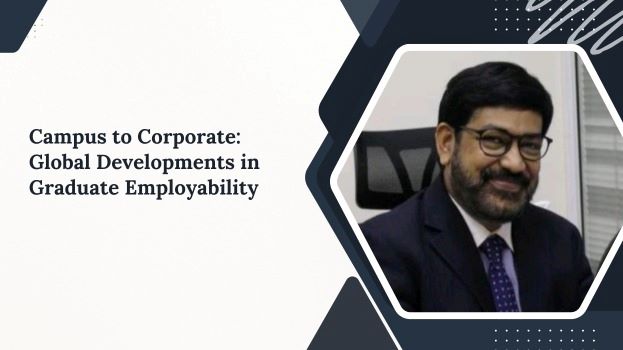
Prof. Vijaya Bhaskara Reddy Palagani
CEO Q-People & Company, Hyderabad, India reachvijay@yahoo.com | www.linkedin.com/in/reachvijay |
The transition from university education to the professional world has entered one of the most transformative periods in the 21st century. For decades, graduates believed that earning a degree would naturally lead to stable employment, upward mobility, and long-term professional security. That expectation, however, has become increasingly uncertain in a rapidly changing global economy shaped by artificial intelligence, automation, digital platforms, remote work, geopolitical instability, and evolving corporate priorities. The challenge facing modern graduates is no longer limited to finding employment after graduation; it now involves developing adaptability, resilience, technological fluency, and human-centered capabilities necessary to remain relevant within continuously shifting labor markets. At the same time, universities, governments, and corporations are struggling to redesign systems originally created for industrial-era economies rather than knowledge-driven digital societies.
The contemporary skills crisis is therefore not simply an educational problem or a recruitment issue. It reflects a deeper disconnect between institutional structures and the realities of twenty-first-century work. Across the world, employers frequently report that graduates lack practical readiness, communication ability, critical thinking skills, and digital competence despite holding formal qualifications. Simultaneously, graduates often feel frustrated because they enter the labor market believing academic achievement alone should guarantee professional opportunity. This mismatch has contributed to rising levels of graduate underemployment, prolonged job searches, and growing anxiety regarding career sustainability. One major reason behind this widening gap is the speed at which technology is transforming professional environments. Automation increasingly handles repetitive cognitive tasks once performed by entry-level professionals. Artificial intelligence systems can now generate reports, analyze data, automate customer interactions, and support strategic decisions. While this technological revolution creates significant productivity gains, it also fundamentally changes what organizations expect from graduates. Employers are no longer searching for individuals who can merely memorize information or complete routine analytical tasks. Instead, they seek professionals capable of interpreting complex information, collaborating across disciplines, exercising ethical judgment, communicating effectively, and integrating human insight with technological systems.
This transformation requires universities to reconsider the purpose of higher education. Traditional educational models were built around fixed curricula, lecture-based delivery, and examination-oriented evaluation systems. Such approaches may provide foundational theoretical knowledge, but they often struggle to prepare students for fluid, interdisciplinary, and technologically integrated workplaces. Increasingly, employers expect graduates to possess not only technical expertise but also adaptability, emotional intelligence, collaborative capability, entrepreneurial thinking, and digital fluency. Consequently, higher education institutions (HEIs) must move beyond rigid disciplinary silos and adopt more integrated, experiential, and industry-connected learning ecosystems. Classroom learning alone is insufficient in preparing students for real-world complexity. Universities must create environments where students engage with practical projects, internships, industry mentors, entrepreneurial incubators, and interdisciplinary problem-solving exercises. Students should work on authentic societal and business challenges while learning to collaborate with peers from different academic backgrounds. Such exposure develops the contextual understanding and practical confidence required in modern professional environments.
The role of faculty members must also evolve from knowledge transmitters to learning facilitators and intellectual mentors. In a world where information is instantly accessible through digital platforms, the unique value of universities lies not merely in delivering content but in cultivating analytical thinking, ethical reasoning, curiosity, creativity, and lifelong learning habits. Educational institutions must therefore focus on helping students learn how to learn, unlearn outdated assumptions, and continuously adapt to emerging technologies and market realities. Digital transformation further complicates this landscape by creating both unprecedented opportunities and deep structural inequalities. Digital platforms allow graduates to access global work opportunities, online certifications, remote employment, entrepreneurial ecosystems, and collaborative learning communities regardless of geographical boundaries. A graduate in a small town can now contribute to international projects or build portfolios visible to employers worldwide. Yet unequal access to technology, internet connectivity, advanced software tools, and digital literacy training risks widening socioeconomic disparities. Students from underserved regions may struggle to compete in labor markets increasingly dependent on technological competence.
This places significant responsibility on governments and policymakers to build inclusive digital infrastructure and modernize national education frameworks. Public policy cannot remain anchored to outdated assumptions that treat traditional degrees as the sole pathway to professional legitimacy. Contemporary labor markets increasingly recognize micro-credentials, certifications, project-based learning, and portfolio-driven skill verification. Governments must therefore design qualification frameworks that recognize diverse learning curricula designs while maintaining educational quality and credibility. Corporate organizations also play a central role in shaping the future employability landscape. Historically, many employers approached recruitment as a filtering exercise focused heavily on university prestige, grade point averages, and standardized aptitude testing. However, these hiring practices are becoming increasingly inadequate in identifying future-ready talent. Modern organizations require professionals capable of continuous learning, collaborative problem-solving, and strategic adaptability rather than individuals who merely excel in examinations. As a result, progressive corporations are shifting toward skills-based hiring models that prioritize demonstrable capability over institutional pedigree. Practical assessments, portfolio reviews, collaborative simulations, and project evaluations are gradually replacing purely credential-oriented recruitment approaches. Organizations increasingly recognize that talent can emerge from diverse educational backgrounds, including self-directed learning pathways, vocational programs, online learning environments, and interdisciplinary experiences. Recruitment alone, however, is insufficient. Corporate onboarding and talent development systems must also undergo substantial transformation. Early-career professionals require developmental ecosystems that integrate technical training, digital tool mastery, communication capability, leadership exposure, and cross-functional collaboration. Organizations must therefore invest in mentorship structures capable of transforming graduate potential into sustained professional competence.
The rise of hybrid and remote work environments adds another layer of complexity to graduate employability. Distributed professional settings require communication clarity, self-management, digital professionalism, and emotional resilience. Graduates entering these environments must learn how to maintain productivity, build trust virtually, and navigate digital workplace dynamics effectively. These are competencies rarely taught explicitly within conventional academic structures. Yet despite the critical roles played by universities, governments, and corporations, the individual graduate remains the central actor within this ecosystem. Modern employability increasingly depends on personal agency and the willingness to take ownership of continuous development. Graduates can no longer assume that a degree alone guarantees professional success or that employers will provide lifelong career stability. Instead, individuals must cultivate proactive learning habits, regularly evaluate their skills, and adapt to emerging industry expectations. The concept of lifelong learning has therefore shifted from an aspirational slogan to a professional necessity. Graduates must continuously update their competencies through self-directed learning, online courses, professional certifications, practical experimentation, and real-world projects. The ability to independently acquire new skills may ultimately become one of the most valuable employability attributes in an economy defined by constant disruption.
Importantly, future employability will depend not only on technological fluency but also on distinctly human capabilities that remain difficult to automate. Emotional intelligence, ethical reasoning, empathy, creativity, leadership, negotiation, and cross-cultural communication continue to differentiate exceptional professionals from purely technical performers. As automation handles routine analytical work, human-centered competencies become increasingly valuable in strategic and collaborative roles. Ultimately, the future of employability depends on creating an integrated ecosystem where universities, corporations, governments, and individuals work collaboratively rather than in isolation. No single stakeholder can independently solve the complex challenges emerging within modern labor markets. Universities require stronger industry engagement, corporations must invest more seriously in talent development, governments need agile policy frameworks, and graduates must embrace continuous growth. The future workforce will not be defined solely by technical expertise or academic achievement. It will be shaped by curiosity, resilience, ethical judgment, digital fluency, emotional intelligence, and the ability to evolve continuously alongside technological progress. Preparing graduates for such a future therefore demands a fundamental rethinking of how societies understand education, professional growth, and human capital in the digital era.
From campus corridors to corporate boardrooms, the future belongs to graduates who turn learning into adaptability, purpose into innovation, and knowledge into impact.
Latest Posts
-
 6th August, 2026
 -
 3rd August, 2026