

|
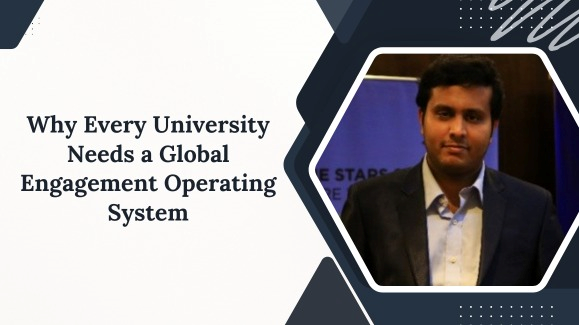
R Karthik
Director General, Confederation of Indian Private Universities (CIPU) |
For many universities, global engagement still looks like a collection of disconnected activities.
A few international MoUs. An occasional faculty exchange. Participation in overseas education fairs. Student mobility agreements. A visiting delegation once every few months.
These are important initiatives. But they are not a strategy.
The world has entered an era where internationalisation can no longer be managed through isolated events or individual relationships. Universities now compete not only for students but also for research funding, innovation partnerships, global talent, philanthropic investment, industry collaborations, and international reputation.
The question is no longer whether a university should engage globally.
The real question is:
Does your university have an operating system for global engagement?
Moving Beyond an International Office
For decades, universities established International Relations Offices to coordinate partnerships and student mobility.
That model served its purpose.
Today, however, global engagement has become institution wide.
It influences:
- Research strategy
- Industry collaboration
- Faculty development
- Student employability
- International accreditation
- Rankings and reputation
- Digital learning
- Transnational Education (TNE)
- Innovation ecosystems
- Government diplomacy
- Alumni engagement
- International fundraising
Global engagement is no longer a department.
It is an institutional capability.
And institutional capabilities require systems.
What is a Global Engagement Operating System?
Think of it as the invisible architecture that enables every part of the university to work together internationally.
Just as an operating system allows a computer's hardware and software to function seamlessly, a Global Engagement Operating System (GEOS) enables every academic and administrative unit to pursue internationalisation in a coordinated, measurable, and scalable way.
It transforms internationalisation from a series of activities into an institutional ecosystem.
Instead of asking,
"Which conference should we attend?"
the university begins asking,
"How do all our global engagements collectively advance our institutional mission?"
That change in mindset is transformational.
The Seven Pillars of a Modern Global Engagement Operating System
1. Global Strategy
Every partnership should support a clearly articulated institutional vision.
Global engagement cannot be opportunistic.
It must be intentional.
The best universities know precisely which countries, regions, sectors, and disciplines they wish to prioritise over the next decade.
2. Partnership Intelligence
Many universities proudly announce hundreds of MoUs.
Yet only a small fraction generates meaningful outcomes.
An effective operating system continuously evaluates partnerships based on measurable impact:
- Joint research
- Faculty mobility
- Student exchanges
- Funding secured
- Publications
- Innovation projects
- Industry collaborations
The focus shifts from counting agreements to measuring value.
3. Research and Innovation Networks
The next generation of research will increasingly be international.
- Climate change.
- Artificial Intelligence.
- Healthcare.
- Quantum technologies.
- Food security.
- Energy transition.
No single university-or country-can solve these challenges alone.
Universities therefore need structured mechanisms to identify global collaborators, build research consortia, and access international funding opportunities.
4. Talent Mobility
Global engagement is ultimately about people.
- Students.
- Faculty.
- Researchers.
- Professional staff.
- Visiting scholars.
- Industry experts.
An operating system should make international mobility simple, strategic, and mutually beneficial-not administratively overwhelming.
5. Technology-Enabled Collaboration
The future of internationalisation is hybrid.
Digital collaboration platforms, virtual exchanges, shared classrooms, collaborative online international learning, AI-powered institutional knowledge systems, and data-driven decision-making are redefining how universities engage globally.
Technology should amplify relationships, not replace them.
6. Institutional Intelligence
One of the biggest challenges universities faces is fragmented information.
Different departments manage different partnerships.
Data sits in multiple spreadsheets.
Institutional memory often leaves when people change roles.
Imagine instead an AI-enabled institutional knowledge system that can instantly answer questions such as:
- Which universities have active agreements in renewable energy?
- Which partnerships are due for renewal?
- Which faculty members collaborate with institutions in Japan?
- Which funding opportunities align with our research priorities?
That is no longer a futuristic vision.
It is rapidly becoming an institutional necessity.
7. Leadership and Governance
Perhaps the most overlooked element of internationalisation is governance.
Without leadership commitment, global engagement remains transactional.
With strong governance, it becomes transformational.
Boards, Vice Chancellors, Presidents, Provosts, Deans, and International Offices must work from a shared global vision rather than independent agendas.
The operating system creates alignment across the institution.
Why This Matters More Than Ever
Higher education is entering a period of unprecedented global competition.
International student mobility is changing.
Transnational Education is expanding.
Governments are investing strategically in knowledge diplomacy.
Artificial Intelligence is reshaping learning.
Industry increasingly seeks globally connected universities.
Universities that continue to approach internationalisation as a collection of events will struggle to remain globally relevant.
Those that build institutional systems will create sustainable competitive advantage.
The winners will not necessarily be the universities with the largest international offices.
They will be the ones with the smartest operating systems.
A Thought for University Leaders
The future belongs to institutions that treat global engagement not as an annual activity plan, but as core institutional infrastructure.
Buildings age.
Technology evolves.
Curricula change.
But a university that develops a robust Global Engagement Operating System builds something far more enduring-a culture where international collaboration is embedded in every decision, every partnership, and every opportunity.
Perhaps the next question every governing board should ask is not:
"How many international MoUs do we have?"
Instead, it should ask:
"Do we have a Global Engagement Operating System capable of delivering our global ambitions?"
Because in the next decade, global engagement will not be defined by the number of partnerships a university signs.
It will be defined by the system it builds to make those partnerships matter.
Latest Posts
-
3rd August, 2026