|
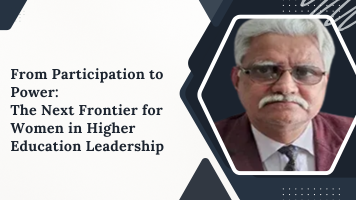
Prof (Dr.) Sanjay Kumar Bahl
Vice Chancellor, Indus International University, Una, Himachal Pradesh vc@iiuedu.in, www.iiuedu.in |
Over the past few decades, India has witnessed a remarkable transformation in the participation of women in higher education. From classrooms to laboratories, from libraries to research conferences, women today constitute a significant portion of the academic community. According to recent educational statistics, female enrolment in universities has steadily increased and, in several disciplines, women now outnumber men. Women scholars are contributing actively to research, innovation, and teaching, playing an indispensable role in shaping the intellectual capital of the nation.
However, while participation has expanded considerably, the transition from participation to positions of institutional leadership remains an important frontier that the academic ecosystem must consciously strengthen. Women continue to be underrepresented in key leadership roles such as Vice Chancellors, Pro Vice Chancellors, Deans, Directors, and members of governing bodies. The challenge before Indian higher education today is not merely increasing the number of women in universities but ensuring that their voices and capabilities are equally represented in decision-making structures.
Universities play a vital role not only in shaping knowledge but also in nurturing inclusive leadership cultures. They are spaces where ideas of equity, justice, and social progress are cultivated. If institutions of higher learning aspire to lead society toward inclusive growth, they must reflect these values in their own governance systems. Ensuring womens leadership in higher education is therefore not just a question of representation but a strategic imperative for institutional excellence.
The benefits of womens leadership in academic institutions are multifold. Research across sectors suggests that diverse leadership teams tend to make more balanced and innovative decisions. Women leaders often bring collaborative approaches to governance, encourage participatory decision-making, and foster empathetic institutional environments. In universities, where intellectual diversity and creativity are essential, such leadership styles can contribute significantly to building vibrant academic cultures.
Moreover, women leaders in universities serve as powerful role models for students and young scholars. When female students see women occupying positions of authority and influence, it strengthens their confidence and aspirations. It sends a powerful message that leadership is not limited by gender but defined by merit, vision, and commitment. In this way, leadership representation can have a cascading impact on generations of learners.
Despite these positive prospects, several structural and cultural barriers continue to limit the progression of women into senior academic leadership. One significant challenge is the persistence of traditional gender roles and societal expectations. Women often carry disproportionate responsibilities related to family and caregiving, which can affect their ability to pursue demanding leadership trajectories. Academic careers typically require long years of research, administrative engagement, and professional networking, which may become difficult to balance with these additional responsibilities.
Another challenge is the leaky pipeline phenomenon in academia. While women enter higher education in large numbers at the student level, their representation gradually declines at higher stages of the academic hierarchy. Factors such as limited mentoring opportunities, unconscious bias in recruitment and promotion, and lack of access to influential academic networks can slow their career progression. Consequently, fewer women reach positions where they are considered for top leadership roles.
Institutional cultures sometimes also play a role. Decision-making forums and governing bodies in universities have historically been dominated by men, which may unintentionally perpetuate systems that are less accessible to women. In some cases, women faculty may hesitate to pursue leadership roles due to a lack of encouragement, recognition, or institutional support.
Addressing these challenges requires a conscious and systemic approach. Universities must adopt policies that actively encourage womens leadership development. One important strategy is the creation of structured mentorship programs where experienced academic leaders guide emerging women scholars. Mentorship not only helps build professional confidence but also provides valuable insights into navigating institutional processes and leadership responsibilities.
Capacity-building initiatives are equally important. Leadership training programs specifically designed for women faculty can equip them with skills in academic governance, strategic planning, financial management, and institutional development. Such programs can prepare women scholars to confidently assume roles such as department heads, deans, and senior administrators.
Workplace policies that support work-life balance also play a crucial role in enabling womens advancement. Flexible work arrangements, childcare facilities, and supportive institutional practices can help women manage professional and personal responsibilities more effectively. When universities demonstrate a commitment to supportive environments, they create conditions where talented individuals can thrive irrespective of gender.
Another important step is ensuring transparent and merit-based recruitment and promotion processes. Institutions should regularly review their policies to identify and address potential biases that may disadvantage women candidates. Representation of women on selection committees and governing boards can also contribute to more inclusive decision-making.
National education policies and regulatory frameworks in India have already emphasized the importance of gender equity in higher education. However, translating these ideals into everyday institutional practices requires continuous commitment. Universities must move beyond symbolic gestures and adopt measurable strategies to improve gender balance in leadership roles.
At the same time, women themselves are increasingly redefining leadership paradigms in academia. Across India and globally, women Vice Chancellors, directors of research institutions, and leaders of academic organizations are demonstrating visionary leadership. They are leading universities through complex challenges such as digital transformation, interdisciplinary research, and global collaborations. Their success stories illustrate that when opportunities are provided, women leaders contribute immensely to institutional growth and innovation.
The journey from participation to power in higher education is therefore not about replacing one form of leadership with another. Rather, it is about building a balanced and inclusive leadership ecosystem where talent, competence, and integrity are the guiding principles. Institutions that embrace diversity in leadership are better positioned to respond to contemporary educational challenges and societal expectations.
Looking ahead, the next frontier for Indian higher education lies in transforming participation into empowerment. Universities must consciously nurture leadership pipelines that encourage women to move from classrooms and research laboratories to boardrooms and executive offices. This transformation requires collaboration among policymakers, institutional leaders, faculty members, and society at large.
When women participate fully in academic leadership, universities become stronger, more inclusive, and more innovative. They reflect the diversity of the communities they serve and embody the democratic ideals that education seeks to promote. Ultimately, empowering women in higher education leadership is not only a matter of gender equity but also a pathway toward building a more progressive and knowledge-driven nation.
As India moves toward becoming a global knowledge leader, the role of women in shaping academic institutions will become increasingly significant. The future of higher education will depend not merely on how many women enter universities, but on how many lead them. The transition from participation to power is therefore the next defining chapter in the journey of women in higher education leadership.
Latest Posts
-
 6th August, 2026
 -
 3rd August, 2026