|
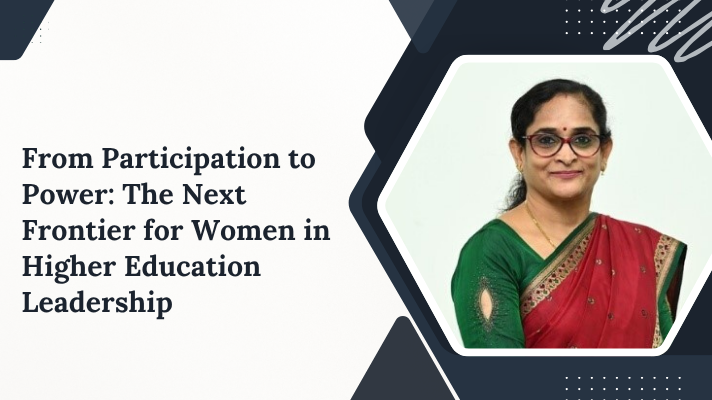
Prof. (Dr.) Vanisree Ramanathan
Program Director, MIT World Peace University, Pune |
An analysis of structural barriers and pathways to leadership equity in academia
The Participation–Power Gap
Higher education worldwide has undergone a remarkable transformation in recent decades, especially in women’s participation. India offers an encouraging picture, with women accounting for nearly 43 percent of total enrolment in higher education. This progress reflects expanded access, changing social attitudes, and rising aspirations among women. However, this achievement remains incomplete. Women occupy only about 10 percent of senior leadership roles, including Vice Chancellors, Controllers of Examinations, and Directors of Research. The sharp contrast between women’s presence in classrooms and their absence in decision-making positions is not coincidental. It is the outcome of deeply embedded structural, cultural, and institutional barriers that continue to shape academic career trajectories.
Structural Barriers and Career Bottlenecks
Academic leadership typically requires a combination of research excellence, administrative experience, and strong professional networks. Paradoxically, these are precisely the areas where women in academia often face persistent disadvantages. Many encounter role mismatches, disproportionate teaching and service responsibilities, limited access to influential circles, and inadequate mentorship. These factors collectively restrict their entry into leadership pipelines.
What is urgently needed is a strong mentoring ecosystem capable of guiding women toward leadership roles. In the absence of such support, many women must navigate complex institutional environments without consistent advice, strategic direction, or exposure to senior leadership. Consequently, they often attempt to steer their careers without the institutional backing routinely available to their male counterparts.
Academic advancement also depends heavily on visible outputs such as research publications, funded projects, and conference participation. Women frequently find themselves disadvantaged on this front as well. Alongside demanding teaching schedules and committee work, they often manage substantial family responsibilities. This imbalance between routine duties and the strategic outputs required for promotion creates a significant career bottleneck. Over time, even highly capable scholars may feel discouraged, perceiving the personal costs of advancement as disproportionately high.
Signs of Progress: A Global Shift
Despite these challenges, there are encouraging developments. Globally, the number of women heading universities has risen significantly. Approximately 50 of the world’s top 200 universities are now led by women, representing a 79 percent increase since 2015. This trend demonstrates that meaningful progress is possible when institutions adopt equitable policies and invest deliberately in leadership development. The present challenge is to accelerate this progress and ensure it spreads across systems rather than remaining limited to a few institutions. Women leaders contribute distinctive strengths to academic governance. Qualities such as integrity, collaboration, and inclusive decision-making often enhance institutional functioning. In contemporary universities, which must balance the expectations of students, faculty, industry, and government, these attributes are not peripheral but central to effective leadership.
Building a Sustainable Leadership Pipeline
Closing the participation–power gap requires more than incremental reforms. Policies such as reservations, scholarships, and expanded hostel facilities have successfully increased enrolment but have not produced a proportional rise in women leaders. Sustainable change demands a deeper examination of the structures governing career progression. Opaque appointment processes, exclusionary informal networks, and performance metrics that overlook the unequal burden of domestic labour must be reformed. Structured mentorship programmes should become integral institutional commitments rather than optional initiatives. Access to role models is especially important, as experienced leaders can demystify career pathways, offer strategic guidance, and help women build professional visibility through research collaborations and networks.
Transparent and gender-neutral evaluation systems are equally essential. When leadership appointments are based on clearly defined criteria rather than informal patronage, women are far more likely to compete successfully. Leadership readiness also plays a crucial role. Effective academic leaders must combine intellectual depth with emotional intelligence, resilience, social awareness, and ethical judgement. Specially designed leadership development programmes for women can strengthen these competencies while building confidence.
Redefining Merit and Institutional Culture
Informal institutional cultures often influence career advancement as much as formal qualifications. Access to influential networks, peer recognition, and the ability to navigate unwritten norms can determine professional success. Women need opportunities to participate fully in these spaces collaborating, increasing visibility, and building the social capital that leadership requires.
Institutions, for their part, must reconsider how merit is defined. Academic excellence should remain central, but evaluation systems must also account for the structural conditions under which scholars work. Broader definitions of contribution should recognise mentorship, community engagement, interdisciplinary collaboration, and team leadership areas where women often contribute significantly but receive limited recognition.
The Case for Change
The argument for greater women’s leadership in higher education is not based solely on fairness. Diverse leadership demonstrably improves decision-making, fosters innovation, and strengthens ethical governance. Universities that reflect the full range of talent and experience are better equipped to serve students, advance knowledge, and engage constructively with society.However, institutional reform alone cannot resolve the issue. Women themselves must step forward with intention and confidence. This begins with recognising their own strengths. Skills developed through years of teaching, mentoring, and institutional service such as consensus-building, vision articulation, and stakeholder management are fundamental to academic governance. Many women already exercise leadership informally; what remains is to claim that role formally.
Persistent obstacles such as self-doubt, absence of role models, and long histories of discouragement must be addressed deliberately. Seeking mentors, accepting challenging assignments, exploring new opportunities, and building supportive peer networks can expand both capability and confidence. Leadership inevitably involves calculated risk, and most successful leaders have accepted positions before feeling fully prepared. Waiting for perfect conditions or explicit invitations often results in missed opportunities.
Looking Ahead
The momentum toward increased women’s leadership in higher education is real, and the stakes are significant. Every woman who advances to a senior role does more than occupy a position she reshapes institutional expectations and expands what future generations consider possible. In doing so, she becomes a visible symbol of change. Ultimately, the future of women’s leadership in academia will depend on a dual process: institutions reforming the structures that constrain advancement, and women refusing to be limited by those inherited structures. Only through this combined effort can the participation–power gap be closed, enabling higher education to fully benefit from the talent it already possesses.
Latest Posts
-
 6th August, 2026
 -
 3rd August, 2026