|
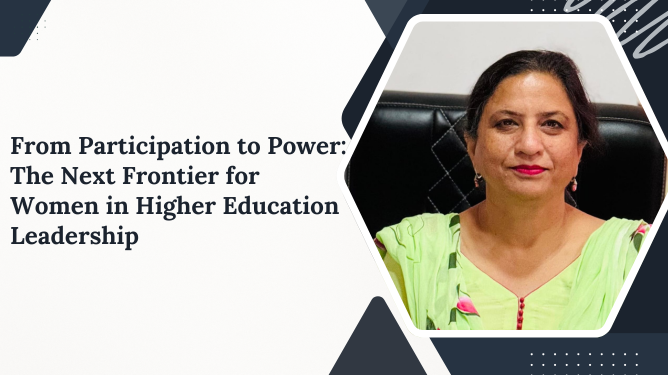
Dr. Navneet Chopra
Dean, University School of Liberal Arts, Sciences and Education Lamrin Tech Skills University Punjab |
The landscape of higher education has witnessed a remarkable rise in women’s participation over the past few decades. Women today not only enroll in universities in large numbers but also excel academically and contribute significantly to research and teaching. However, this progress in participation has not been equally reflected in leadership roles. Even though women earn a substantial proportion of doctoral degrees globally, representation declines at senior professional levels. The real challenge now lies in transforming participation into power—ensuring that women rise to positions where they can influence policies, shape institutions, and lead change. Institutions must create systems where women leaders are not exceptions, but norms.
The Leaky Pipeline in Leadership
Despite their growing presence, women remain underrepresented in top leadership positions such as vice-chancellors, deans, and directors. This lack of equitable outcomes highlights a leaky pipeline in the higher education system. This gap is not due to a lack of capability but rather a result of persistent structural, cultural, and psychological barriers. Societal expectations, unconscious bias, limited access to mentorship, and work-life balance challenges often hinder women’s upward mobility in academia.
Invisible Barriers: Understanding the Glass Ceiling
Females in academia frequently find themselves confined to specific roles such as teaching, leaving little time for research. They often face the “first glass ceiling,” which refers to invisible barriers hindering achievements—evident in both horizontal and vertical segregation. Horizontal segregation refers to the underrepresentation of women in certain fields of study, while vertical segregation becomes evident in the limited number of women attaining leadership positions.
Inner Strength: The Power of Self-Belief
However, beyond these external barriers lies an equally important internal dimension—the need for self-belief, resilience, and a strong sense of self-efficacy. Women must recognize their capabilities and cultivate the confidence required to aspire to and sustain leadership roles. It is essential that they view obstacles not as barriers, but as opportunities for growth. Challenges, setbacks, and failures should be embraced as learning experiences that prepare them for higher responsibilities.
Equally important is the concept of self-efficacy—the belief in one’s own abilities to achieve goals and overcome challenges. Without this inner conviction, even the most qualified individuals may hesitate to step into leadership roles. Women must actively build their confidence, assert their ideas, and take initiative in decision-making spaces. As Sheryl Sandberg has emphasized, “In the future, there will be no female leaders. There will just be leaders.”
Institutional Responsibility: Creating Inclusive Systems
At the same time, institutions of higher education must play a proactive role in facilitating this transition from participation to power. Creating inclusive and supportive environments is essential. This includes implementing transparent and equitable recruitment and promotion policies, establishing mentorship and leadership development programs, and addressing unconscious bias within institutional structures. Providing flexible working arrangements, childcare support, and family-friendly policies can further enable women to balance professional and personal responsibilities.
Resilience and Resolve: The Way Forward
The journey from participation to power is not solely an institutional responsibility; it is a shared societal goal. Families, communities, and policymakers must work together to challenge stereotypes and create an environment where women are encouraged to pursue leadership roles. Education systems should emphasize leadership development from an early stage, nurturing confidence and ambition among young women.
Women in higher education must embrace a dual approach—seeking external support while strengthening their internal resolve. They must be strong enough to confront challenges and courageous enough to turn them into opportunities. Every obstacle overcome adds to their experience, resilience, and leadership capacity.
Conclusion: From Empowerment to Systemic Change
Let us move from empowering women to redesigning systems
In conclusion, the shift from participation to power represents the next critical phase in the journey toward gender equity in higher education. Recognizing the principle that “what gets measured gets attention,” monitoring progress in gender equality is essential. While significant strides have been made in increasing women’s access to education, the true measure of success lies in their representation in leadership roles.
Women must harness their strength, build self-efficacy, and take bold steps forward, using obstacles as springboards for growth. With the right mindset, support systems, and opportunities, there can indeed be no stopping them. The future of higher education depends on inclusive leadership—and empowering women to lead is not just a matter of equality, but a necessity for progress and excellence.
Latest Posts
-
 6th August, 2026
 -
 3rd August, 2026