


|
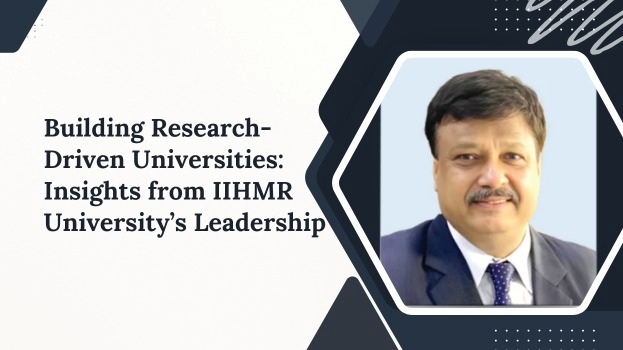
Dr. P.R. Sodani
President (Vice Chancellor), IIHMR University, Jaipur |
In an increasingly complex and interconnected world, universities are no longer judged solely by the degrees they award or the numbers they enrol. Their true value lies in the knowledge they generate, the policies they inform, and the societal challenges they help solve. Research-driven universities sit at the heart of this transformation, serving as engines of evidence, innovation, and leadership. IIHMR University, Jaipur, offers a compelling example of how research can be systematically embedded in the mission and functioning of a specialised university.
Research as a Core Institutional Purpose
At IIHMR University, Jaipur, we have a legacy of over 40 years in Health Management Research, dating back to the founding of the Indian Institute of Health Management Research in 1984. Initially, from 1984 to 1994, it focused on research to understand the managerial problems of health systems and identify management solutions to improve their performance. Research is treated as a core institutional purpose, not a peripheral academic activity. With this clear conviction, IIHMR served as a trusted knowledge partner to governments, healthcare institutions, and communities.
This philosophy has shaped IIHMR evolution into a university where teaching, research, and policy engagement are deeply integrated. Academic programmes expose students not only to theory but also to applied research methods, health systems analysis, and real-world problem-solving. Faculty are encouraged to align their research agendas with national health priorities and global development goals, ensuring relevance alongside academic rigour.
Institutional Structures that Enable Research Excellence
Building a research-driven university requires deliberate institutional design. One of IIHMR University defining practices has been the creation of dedicated research centres focused on priority areas in health systems strengthening: the Centre for Health Economics, the Centre for Gender Studies, the Centre for Innovation, Incubation, and Entrepreneurship, the Centre for Behavioural Sciences, the Centre for Clinical Research, and the Centre for Environmental Health. These centres serve as a platform for large-scale studies, program evaluation, and programme effectiveness areas critical to policy formulation and system reform.
Equally important has been the role of the IIHMR Foundation, co-founded by Prof. Sodani, which serves as a bridge between academia and practice. Through the Foundation, the University has engaged with national ministries, state governments, multilateral agencies, and global development partners. These collaborations have enabled IIHMR to undertake policy-relevant research, advisory assignments, stakeholder consultations, policy advocacy, and capacity-building initiatives, thereby reinforcing the University position as a credible knowledge institution.
Global Standards, Local Relevance
A defining feature of IIHMR University research culture is its balance between global standards and contextual relevance. Research methodologies, ethical frameworks, and publication standards are benchmarked against leading global institutions, while research questions remain firmly rooted in India health system.
This dual orientation has enabled IIHMR to make meaningful contributions to the global discourse while addressing pressing national and regional challenges. Research outputs from the University have informed health financing reforms, programme evaluations, quality improvement initiatives, and governance frameworks across diverse settings.
Mentorship and Research Capacity Building
People ultimately build a research-driven university. Prof. Sodani has consistently emphasised mentorship as a cornerstone of institutional growth. At IIHMR, faculty development and research capacity building are treated as long-term investments. Young faculty members and research scholars are mentored to develop independent research trajectories, publish in peer-reviewed journals, and engage with policy audiences. Prof. Sodani created an enabling environment for faculty and research scholars through the Research Promotion Policy and the Internal Research Grants.
Students, too, are integrated into the research ecosystem. Through dissertations, field studies, and collaborative projects, they learn to translate data into insights and insights into action. This exposure ensures that graduates leave the University not only as managers or public health professionals but as critical thinkers capable of using evidence to drive change.
Aligning Research with National and Global Agendas
IIHMR University research agenda closely aligns with India evolving health priorities and global commitments, including the Sustainable Development Goals (SDGs). Whether addressing universal health coverage, health workforce development, quality of care, or health system resilience, the University work reflects an understanding that research must ultimately serve the public good.
Looking ahead to India@2047, Prof. Sodani envisions universities playing a far more proactive role in shaping policy and leadership. In his view, research-driven institutions must serve as neutral platforms for dialogue, innovation, and accountability supporting governments and systems with credible evidence while nurturing leaders who can navigate complexity with integrity.
Conclusion
IIHMR University journey shows that becoming a research-driven university is not the outcome of isolated excellence but the result of sustained leadership, institutional clarity, and purpose-driven scholarship. As a higher education institution in India and the Global South, IIHMR University exemplifies how research, when thoughtfully embedded in the institutional DNA, can transform universities into catalysts for national and global health progress.