

|
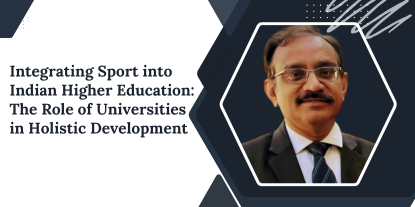
Prof. (Dr.) Yogesh C Goswami
Vice Chancellor, Shri Vaishnav Vidyapeeth Vishwavidyalaya, Indore, 452009 ycgoswami@gmail.com |
Indias universities have always been catalysts of social change. From shaping intellectual traditions to nurturing leadership for public life, higher education institutions have played a defining role in the nations progress. Today, as India aspires to become a global knowledge and innovation hub, universities are once again being called upon to reimagine their purpose. One such critical reimagining lies in how we perceive and integrate sport within higher education not as an extracurricular diversion, but as a powerful instrument of holistic education, leadership development, and student well-being.
Sport and the idea of holistic education
The vision of holistic education, strongly articulated in National Education Policy 2020, emphasises the balanced development of cognitive, physical, social, and ethical capacities. Sport naturally advances this vision. It builds resilience, discipline, teamwork, emotional intelligence, and the ability to handle both success and failure attributes that no classroom lecture alone can impart.
In a time when universities are witnessing rising levels of stress, anxiety, and disengagement among students, sport also emerges as a vital enabler of mental and physical well-being. Regular physical activity has been shown to improve concentration, reduce stress, and enhance overall academic engagement. Universities that consciously invest in sport are, therefore, not diluting academic seriousness; they are strengthening it.
Universities in Indias sporting ecosystem
Indias higher education system, one of the largest in the world, has immense potential to shape the countrys sporting culture. Universities sit at a critical intersection between school-level participation and professional sport where young adults make life-defining choices. For many students, the university campus is the first space where they encounter structured sport, professional coaching, and competitive exposure.
Historically, however, sport in Indian universities has been unevenly developed. While a few institutions have built strong traditions and infrastructure, many campuses still treat sport as peripheral. Addressing this imbalance requires institutional leadership, long-term planning, and alignment with national priorities.
The distinctive role of private universities
Private universities have emerged as a dynamic force within Indian higher education, and their role in strengthening the sporting ecosystem deserves special attention. With greater autonomy in governance, curriculum design, and resource allocation, private universities are uniquely positioned to innovate and lead.
Several private universities have demonstrated that academic excellence and sporting excellence are not mutually exclusive. By introducing flexible academic schedules, credit recognition for sports participation, and structured mentoring for student-athletes, they have enabled learners to pursue both education and competitive sport with confidence. Sports scholarships, residential academies, and access to professional coaching have further widened participation, particularly for students from rural and underserved backgrounds.
Importantly, private universities have also invested in multi-use sports infrastructure and sports science support including physiotherapy, nutrition, and performance analytics thereby creating ecosystems that mirror global best practices. These initiatives not only benefit athletes but also open new academic and research pathways in sports science, management, and rehabilitation.
Integrating sport with academics: lessons from practice
One of the most significant shifts in leading universities has been the integration of sport with academics rather than their separation. Institutions that have embedded credit-based physical education, yoga, or fitness modules within the academic timetable report better student participation and reduced stigma around sport. In some universities, leadership roles within sports teams such as captains, event coordinators, and student coaches are formally linked to learning outcomes in leadership, ethics, and management. Students are encouraged to reflect on their sporting experiences through assignments and mentoring sessions, translating on-field learning into academic and professional competencies. Such models echo the experiential learning traditions of Indian Knowledge Systems, where education was rooted in practice, reflection, and values.
Sport as a leadership laboratory
Sport provides a natural training ground for leadership. On the field, students learn decision-making under pressure, conflict resolution, accountability, and collective responsibility. Universities that consciously recognise this dimension have begun treating sports teams as leadership laboratories Case reflections from several private universities indicate that student-athletes who receive structured mentoring often emerge as effective campus leaders heading student councils, cultural bodies, and social initiatives. Their exposure to discipline, time management, and teamwork equips them for leadership roles well beyond sport, enhancing employability and civic engagement.
Student well-being and campus culture
A vibrant sporting culture contributes significantly to campus life. Intramural leagues, inter-hostel tournaments, and annual sports festivals foster peer bonding, inclusivity, and institutional pride. For students who may not aspire to competitive sport, these activities offer spaces for recreation, stress relief, and social connection. Universities that prioritise inclusive participation especially for women students, students with disabilities, and first-generation learners create environments where sport becomes a shared cultural experience rather than an elite pursuit. Such campuses tend to exhibit stronger student engagement, lower dropout rates, and healthier learning climates.
Reconnecting with Indian Knowledge Systems
Indias civilisational understanding of education, reflected in Indian Knowledge Systems (IKS), offers valuable insights for contemporary universities. In ancient centres such as Nalanda, physical discipline through yoga, martial practices, and daily routines was integral to intellectual and ethical training. The aim was balance of body, mind, and character. Modern universities can draw inspiration from this wisdom by blending traditional practices such as yoga and meditation with modern sports science. This culturally rooted yet globally relevant approach strengthens student well-being while reaffirming Indias intellectual heritage.
Leadership and institutional commitment
Ultimately, universities become catalysts for sporting culture through leadership choices. Vice-Chancellors, governing bodies, and academic councils must place sport within the core institutional mission. This requires dedicated budgets, trained professionals, transparent policies, and measurable outcomes participation rates, student well-being indicators, leadership development, and academic retention.
Private universities, with their agility and innovation capacity, can act as exemplars, demonstrating scalable models that others can adapt. Collaboration between public and private institutions, national sports bodies, and industry partners can further amplify impact.
Looking ahead
If Indian higher education is to truly serve nation-building, it must produce graduates who are not only intellectually capable but also physically healthy, emotionally resilient, and socially responsible. Sport, when thoughtfully integrated, helps achieve all these goals.
Universities especially private institutions have the opportunity to redefine the relationship between learning and physical culture. By doing so, they can strengthen Indias sporting ecosystem, enrich student life, and reaffirm the timeless truth that education flourishes best when the mind and body grow together.
Latest Posts
-
 3rd August, 2026